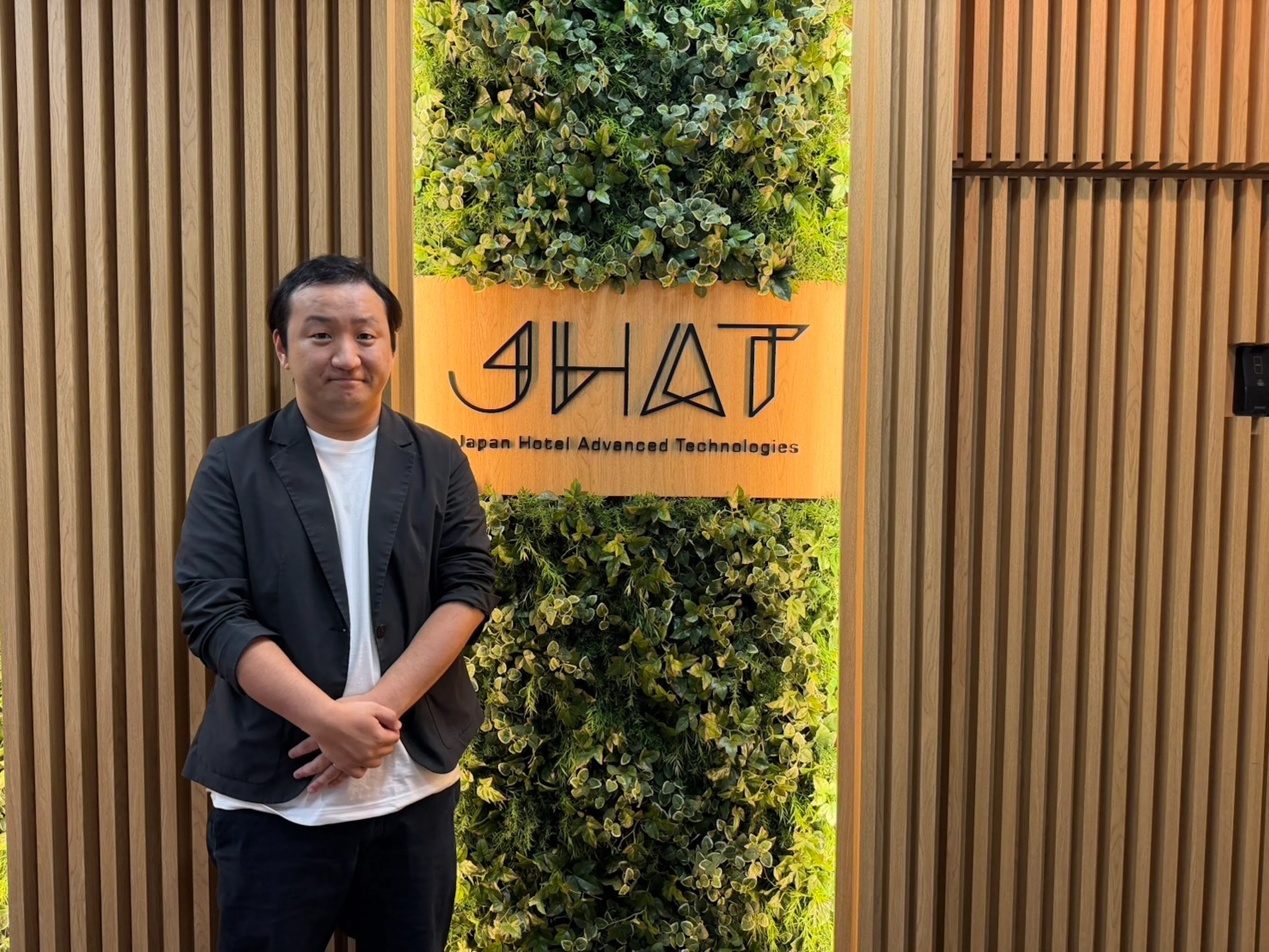
JHAT Co., Ltd. operates hotels and apartment hotels across Japan under several brands, centred on hotel MONday. Its "apartment type" rooms — 35 to 50 square metres, with a kitchen and washing machine — draw guests who are around 90% inbound travellers, roughly half of them from Europe and the Americas.
With many properties staffed by just one or two people at the front desk, the company had already adopted a chatbot to reduce the volume of phone calls. As they kept using it, though, three problems surfaced: the burden of registering FAQs forever, answers whose tone varied from property to property, and the fact that what they call "multilingual support in the true sense" was not actually happening.
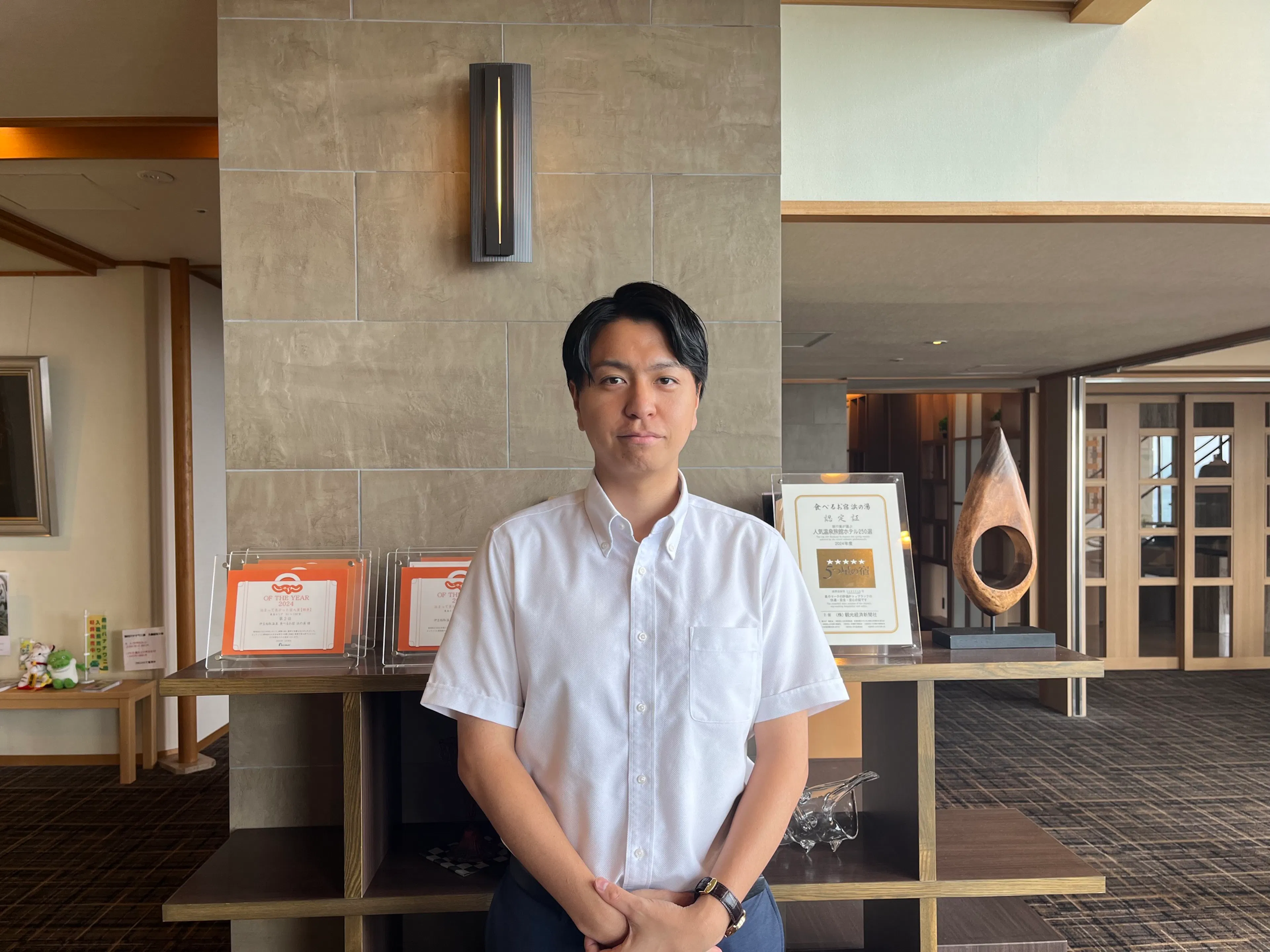
We spoke with Tomotaka Isono of the Corporate Planning Division about why they switched to NEWT Chat and what changed on the ground afterwards. (Interviewer: Hiroki Ukeda, Reiwa Travel)

Ready to try NEWT Chat for yourself?
The free trial needs no credit card. See adoption results and pricing details in the guide.
Around 90% inbound in the apartment type: several distinct brands rolled out nationwide
— Could you start by telling us how your brands differ and who your guests are? We'd love to hear the share of inbound guests and where they come from, too.
Isono: Our brand MONday divides broadly into what we call the hotel type and what we call the apartment type. Our defining feature is that apartment type — rooms of roughly 35 to 50 square metres, a little more spacious, where a good number of people can stay in a single room. They come with a kitchen and a washing machine, so what we build with a focus on longer stays is the main part of the brand.
We run several other brands as well. GRAND MONday sits above that as a premium brand, with more generous room design and a higher level of service. GRAND MONday Resort, which we opened recently, is a resort brand built for longer stays. TABI is a brand with a much stronger focus on Japanese style — tatami in every room, for instance — designed to appeal particularly to inbound guests from Europe and the Americas. We also run ICI HOTEL and Good MONday, which lead with design.
In terms of the mix, the apartment type is already around 90% inbound guests, and for TABI the figure is higher still. About half are what we'd call guests from Europe and the Americas — around 50% from Europe and the United States. Beyond that, Southeast Asia and Taiwan account for a lot. For communication, English is the most common by far. Because guests come from so many countries, a good proportion of our staff are non-Japanese, and we build our shifts around people who can work in English plus Japanese plus one more language of their own.

"Let's review it once": how a DX stocktake put the chatbot on the list
— Could you tell us about your remit, and the position you were in for this NEWT Chat rollout? We'd also like to hear how the chatbot review began.
Isono: I look after two things. The main one is the Corporate Planning Division — dealings with owners, preparing contracts for new properties, annual budget planning, that sort of work.
The other is that the company hadn't previously had a department for this kind of thing, so I work in something like a DX role, leading the company's DX project by project, especially around AI: introducing it, spreading it, running training. On the AI side, I'm currently using Claude Code to build internal business applications, to automate reports we used to put together entirely by hand, and to build internal dashboards.
Since there had been no department or division handling systems when I joined, we decided that as far as anything system-related was concerned, let's review it once. So this began with surveying which systems and which services each department had adopted. On the chatbot specifically, there was a sense that it was very heavy on the site, and on cost — I build the internal budget as well — that it accounted for a fairly large share of our system spend. So the question became whether we could revisit it. At just the right moment, we received an introduction to NEWT Chat on X.
"We had to keep registering them ourselves": the never-ending updates FAQ operation created
— Could you tell us why you originally adopted a chatbot, and what problems emerged once you were actually running it?
Isono: The original aim was to reduce phone calls. Although it has become relatively less frequent, we do still get calls coming into the properties. And our properties are never especially large — 40 or 50 rooms, fewer than at other hotel companies — so there is often just one or two people on the front desk. If they pick up the phone, they can't attend to a guest who arrives at the desk. Because of situations like that, the attempt to reduce phone calls as far as possible is what led to trying a chatbot, as I understand it.
That said, while the properties no longer had to handle things by phone, there was still the preparation behind each answer. You have to register the FAQs in the back end, which meant we had to keep registering them ourselves across a wide range of topics, and whenever the content of the website changed we had to keep updating it too. A separate workload was being created, and that was the big issue.
Answers that varied by property, and the absence of "multilingual support in the true sense"
— How did you find the language side, and the quality of the answers?
Isono: With the chatbot we used at first, there was a slight UX problem on language: guests had to choose from a multilingual setting themselves. I think the people making inquiries were almost all Japanese. So there were areas where we couldn't really attend to multilingual support in the true sense.
And because it was operated by each property, the way words were used in the FAQs ended up varying quite a lot depending on the staff member registering them and on the property. Even for the same answer, some properties were long and highly polite while others were extremely brief. We run several brands, and even within a single brand, aligning tone and manner was one of the things we struggled with.
Ready to try NEWT Chat for yourself?
The free trial needs no credit card. See adoption results and pricing details in the guide.
Four deciding factors — site load, language coverage, maintenance and price — and a switch that was just swapping the embed tag
— We hear you compared other services. Could you tell us why you chose NEWT Chat in the end, whether replacing something guest-facing worried you, and how the switch actually went?
Isono: We looked at several, but services that said they would answer with AI barely existed in the first place. When we actually asked around, a lot of them wanted us to accumulate information in FAQs, just as with the product we'd had before, and there were fairly tight limits on the number of languages supported.
The points we decided on were the load on the site, language coverage, and the fact that it needed little maintenance. Those plus price — four points in all — are what we took through internal approval.
As for the switch itself, I think it went quite smoothly. There was an embed tag, and simply swapping it over changed essentially everything. In terms of preparation, we were given a test screen, had the property teams ask it all sorts of questions, and checked whether it could answer the content of our FAQs at a minimum. That was about the extent of it.
So we no longer needed to visit each property one by one to explain it, and the rollout was very smooth. The properties basically no longer have to do maintenance either, so we cut the cost of explaining all this by a large margin.

"It really does feel like a conversation": away from mechanical replies, with tone aligned across properties
— Where did you feel the difference from your previous chatbot most strongly?
Isono: Let me answer for guests and for those of us operating it separately. For guests, because the AI answers properly in natural language, as a chat it really does feel like a conversation. So the fact that the answers don't come out mechanically is one big benefit. Compared with before, the data suggests there is a good amount of back-and-forth within a single session.
On the operations side, the effort that goes into how we assure maintenance and quality is much lower than before, and that's significant. Now that answers come from AI and are aligned to a reasonable degree, that's something we no longer have to worry about.
From overseas, chat is easier than a phone call: a felt increase, and plans to improve the site
— Looking at the chat exchanges, what trends have emerged? We'd also like to hear about any moves to improve the site or your services off the back of that.
Isono: From the data, I can feel that the usage rate among guests from overseas is rising sharply. With phone calls, it's basically Japanese guests — and almost always people calling from within Japan. Calling from abroad is a genuinely high hurdle. Until now I think there was little more than emailing an inquiry through an OTA, but the number of guests casually making inquiries over chat has grown a great deal. So my sense is that the share of direct bookings from non-Japanese guests is rising too.
On improvements, we currently receive regular reports, and the hope is to build a structure internally and improve things based on them. Being able to see quantitatively that a lot of inquiries are coming in on a given topic, or that guests are getting stuck on a particular point, is genuinely valuable. I think all sorts of moves — improving parts of our website, changing how we word things — could come out of that from here.
Completing bookings in chat is next: what he recommends to peers — "ease of adoption" and "multilingual support"
— Finally, could you tell us what you hope to do with it going forward, how the AI phone trial is progressing, and how you would recommend it to others in the industry?
Isono: What we want is a setup where a booking can be completed end to end — where there is effectively staff on the web supporting the guest right through to the booking. And because we have several hotels within the group, if someone is looking at a nearby hotel that turns out to be full, or the price doesn't work, we can tell them there's another one close by. If what a person used to be able to suggest can be completed on the web, I think we'd see more cases of guests booking within our group, so that's something we'd very much like to do. If we can also handle exchanges with guests during their stay, our service could cover a much wider range.
On the AI phone side, we are running a trial with NEWT Voice, the new AI service we were introduced to.
If I were recommending it to someone in the industry, I'd split it into two. The first is how easy it is to connect. There's almost nothing to prepare on our side: you connect your website, a test screen appears, and once you've tried a few things and are happy, you embed the tag and you can release. That speed to release is something nobody can beat, so even just to try it, I think you can get going straight away.
The second is languages. Hotels have to build websites that guests from many countries can read, and the data suggests that even guests who book via an OTA will look at your own website once to compare and get a feel for the place. Being able to handle the finer questions there, over chat, matters a great deal.
— Away from building FAQs forever, with tone aligned across properties, and now able to hear from overseas guests who previously found it hard to reach you. It's been a genuine pleasure to hear. Thank you so much for your time!
Note: Information about the services and the property in this article reflects the time of the interview and may differ today.